The rail network
Old Marta goes where the rails go. How the lines are laid out, how they follow the front, and why a junction is worth a shell.
Old Marta only moves on rails. The rail network is how you choose your stretch of the front, how every army feeds its trenches, and one of the best targets in the war. The main lines out of each army's cities are the same for every player. Beyond them, the network follows the war: new lines are laid as a front moves forward, and old ones are left behind when it is pushed back.
How the lines are laid out
| Part | Where it runs |
|---|---|
| Main lines | 3–4 per army, out from its cities |
| Main line behind the front | Roughly parallel to the front, about 8–12 km back |
| Sidings | Branching toward the front every 1–2 km, so they sit 4–8 km behind your fire trench |
| Junctions | Out in the contested belt between the armies |
A siding further back is safer, but less accurate, and it reaches fewer deep targets. A siding further forward hits harder and deeper, but the enemy finds you faster. See Charges and range and Exposure and moving the gun.
Choosing a siding
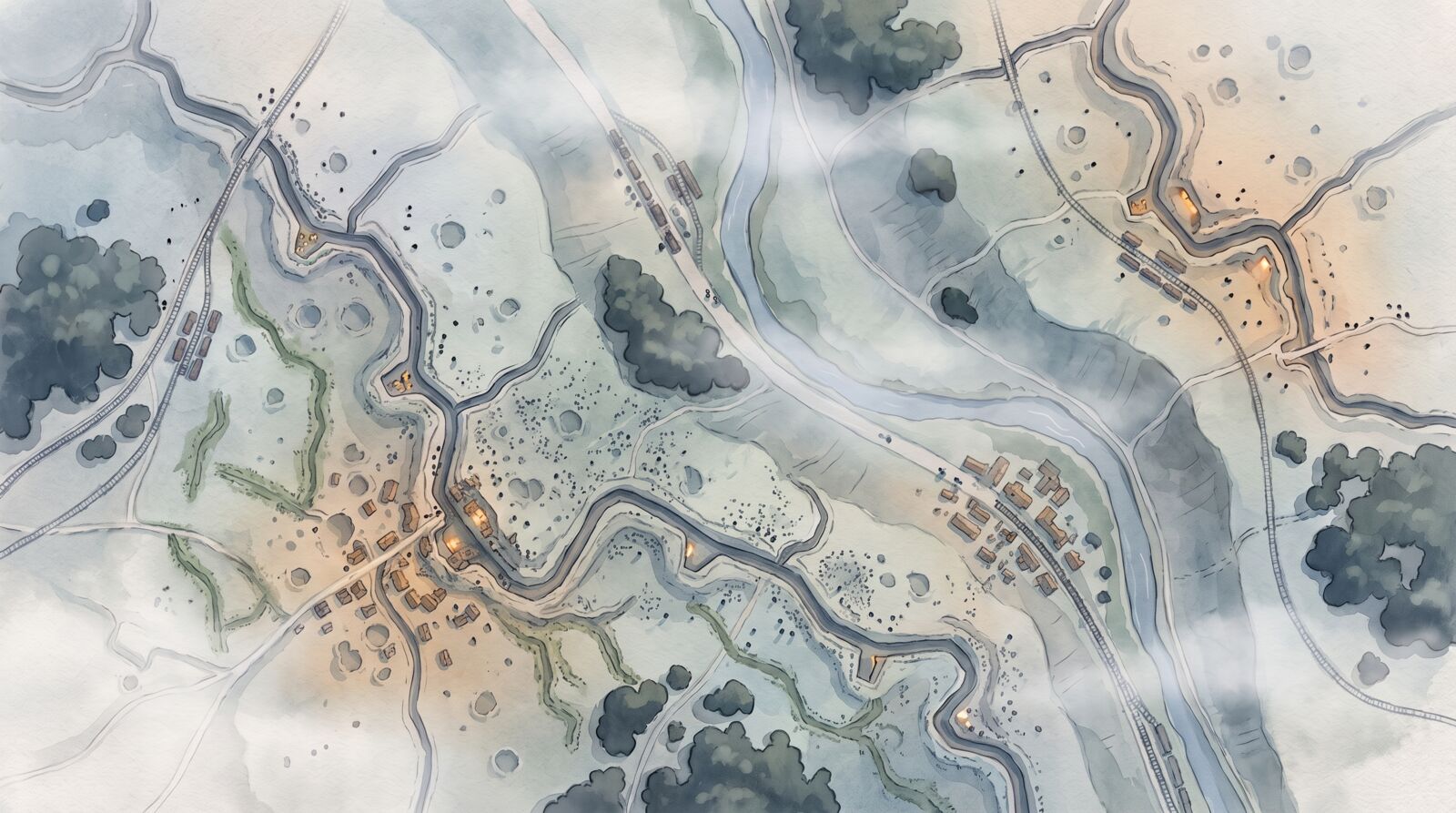
On the map table you pick a siding, and the train travels there in compressed time, about 6 to 10 s per km, while the camera follows over the watercolour landscape. On the way you pass villages, depots and quiet stretches of front, hear the radio and receive letters. You can stop at any siding along the route. Wherever you stop, the front in reach becomes your fight. See One continuous war.
Following the front
- When an army's front moves more than about 3 km beyond the reach of its sidings, engineers lay a new line closer to the front over the next hours.
- When an army is pushed back, a new line is built further behind.
- Old lines are never removed. They become overgrown spurs, and if the enemy advances past them, they end up behind enemy lines. A captured line can be repaired and used by the army that now holds it.
Track near the front
Track within about 2 km of the front gets shelled to pieces. Damaged track needs time to repair. Destroyed track stays broken until the front moves away again.
When the front cuts a line
When the front cuts a line, your route to a sector changes. You use what is still intact, or you travel around on another line, which costs time. The route on the map shows the detour.
The line past Velde is shelled. I'm taking the loop around the canal.
Rails as targets
Enemy junctions, bridges and sidings are high-value targets. Cutting them cuts supply to the trenches they feed, and it can trap an enemy gun on a dead-end siding. The Lowmarch has about 25 rail junctions and bridges, and every army needs them. See Supply and Finding enemy guns.