The shot
Spot, solve, set, load, fire, watch, correct. The minute or so that the whole game is built around.
Everything in Shellfall exists to make one shell worth firing. Choosing the target, working out the solution, the weight of the boom, the long quiet flight over the painted valley, the impact that reshapes the ground, and the war answering back: that is the game. If a feature does not make the next shot mean more, it is not in Shellfall.
The loop
A shot takes 30 to 90 seconds, and it always runs the same way.
- Spot. Find something worth hitting. Targets come from recon: a spotter's report, a balloon's live circle, a recon plane's photographs, or the crossing bearings of an enemy gun. See Recon: spotters, balloons and planes.
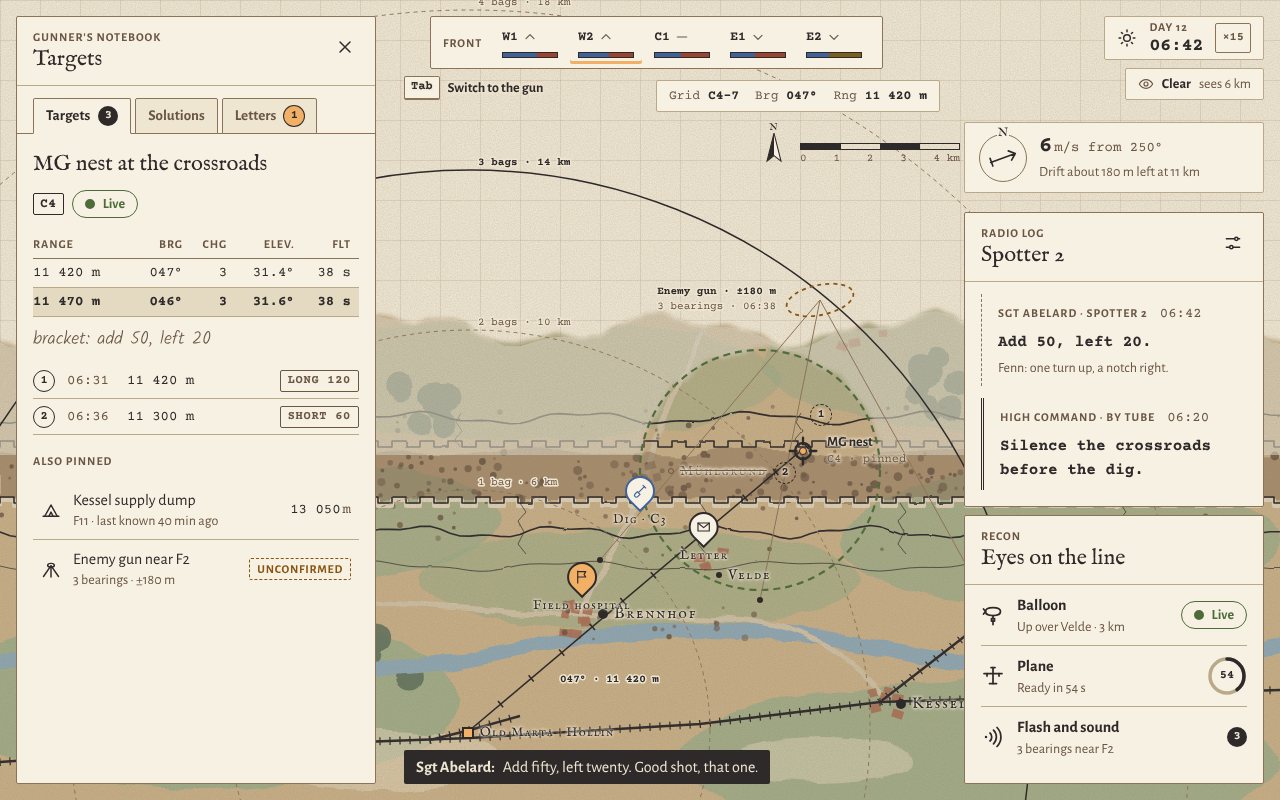
- Solve. On the map table, read the target's bearing and range from Old Marta's siding, then look up the elevation and flight time in the firing table. See Ballistics and the firing table.
- Set. In the gun yard, turn the barrel to the bearing and raise it to the elevation. The turntable is heavy: about 6° a second.
- Load. Pick a shell from the ammo rack and choose how many powder bags to load. See Shells and Charges and range.
- Fire. Hold Space for a second to pull the lanyard. Recoil shakes the yard and a smoke ring rolls across the siding.
- Watch. The shell flies for 25 to 60 seconds. This is the quiet moment, below.
- Correct. A spotter radios where it landed, and the correction goes straight into your next solution.
Most targets take two to four shots. The first rarely lands exactly where you meant it to, so you bracket: one long, one short, then split the difference.
Add 50, left 20.
Fenn: one turn up, a notch left.
The quiet moment
At these ranges a shell is in the air for most of a minute. It leaves the gun yard with a roar; on the map table a small marker crawls along its arc and disappears into the fog. The music drops. The crew pours tea, Fenn counts the seconds and Pip watches the sky.
Then a rumble arrives, late and far away, and the radio crackles with what the spotters saw. If a spotter, balloon or plane can see the spot, about 150 m around the impact turns live for 15 seconds, so you see what your shell did before the fog closes over it again.
When the loop breaks
Every shot tells the enemy a little more about where Old Marta is. Sooner or later their sound-rangers and flash-spotters have enough bearings to find her, and the loop stops for the biggest decision in the game: limber up and move to another siding. From the new siding every bearing and range is different, so your pinned solutions turn stale until you work them out again. See Exposure and moving the gun.
Help when you want it
The gunner's notebook keeps the busywork away without doing the thinking for you. One click pins a target, a spotter's correction or a row of the firing table. Difficulty settings decide how much the notebook fills in, from "suggests the full solution" to "blank page", and the Gunner's assist option fills in the whole firing solution for players who want the battlefield without the arithmetic. See Accessibility.