Moving Marta before they find her
Read the exposure meter, know the warning signs, and get Old Marta to a new siding before the enemy's ranging shots find her.
Every shot tells the enemy a little more about where Old Marta is. Their flash-spotters and sound-rangers need two or three good observations to triangulate her, and then their guns start hunting. Moving is her only defence, and the skill is going before the shells arrive.
This tutorial follows the current design and will be rewritten against the game when relocation is built; in the campaign you first move Marta in the Winter season. You will need: a few shots fired from one siding (Your first shot) and the rail network on the map table (The rail network).
Steps
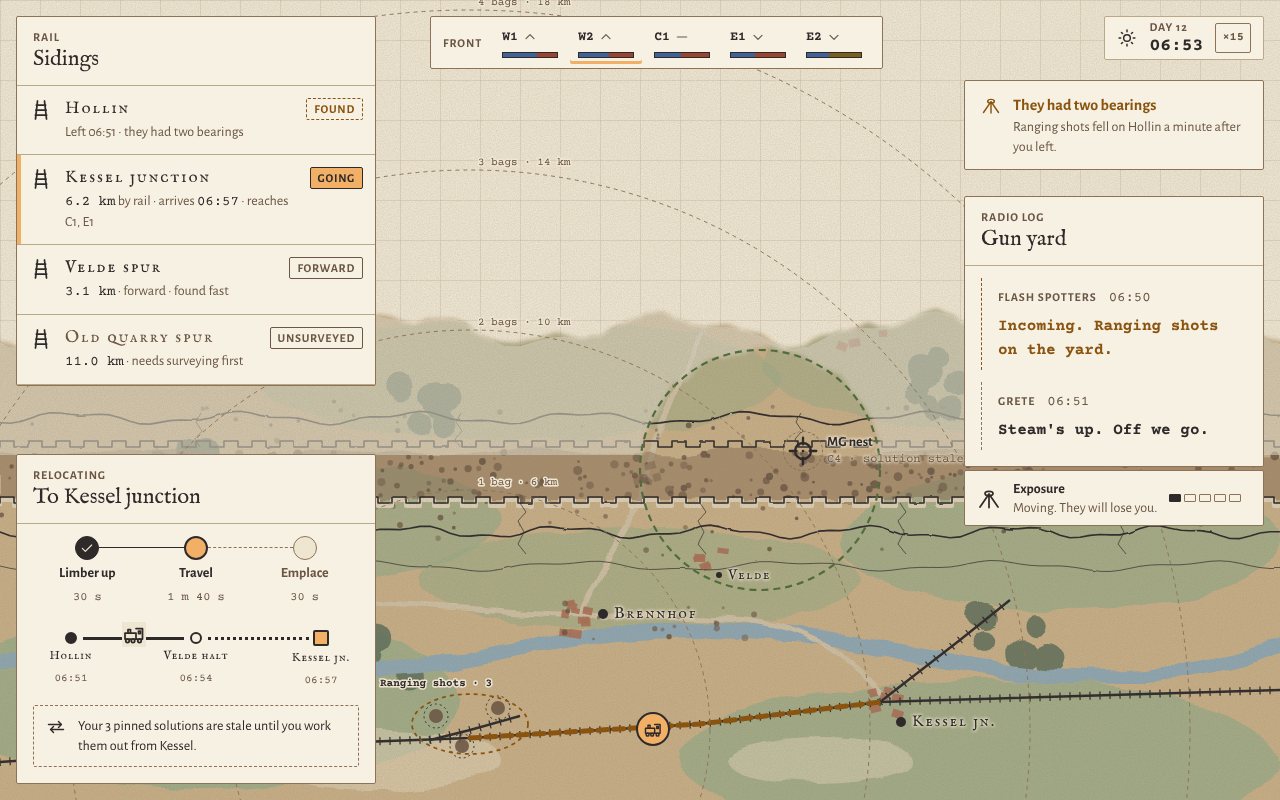
- Watch the exposure meter. It sits top left in the gun yard, and a small gun window on the map table shows it too. Every shot adds to it. Big charges, night firing and a missing camouflage net add more; time and moving take it away. Its five segments come with words, not a percentage: "One bearing on you." Later, "They have two bearings. Move soon." At four segments the game suggests moving. It never makes you.
- Know the warning signs. First the radio reports an enemy sound-ranging balloon up. Then ranging shots land in the gun yard, wide at first, then creeping closer: they are bracketing you the way you bracket them. You hear each one 3–5 s before it lands.
Incoming. Ranging shots on the yard.
- Pick a siding. Press R, then click a siding on the map table (gamepad LB). The sidings list gives each one's distance by rail and the sectors it reaches. From Hollin, Kessel junction reaches C1 and E1. Velde spur is forward and gets found fast. Old quarry spur needs surveying first; you can only move to a surveyed siding. Further back is safer but less accurate and reaches fewer deep targets. Further forward hits harder and deeper, and is found sooner.
- Confirm and limber up. Before you go, the game tells you the cost: your pinned solutions will go stale, and exposure will drop to zero. Then Grete gets the little engine, Pudding, moving.
Steam's up. Off we go.
- Limber up
- Travel
- Emplace
- Ride it out. Limbering up takes about 30 s, travel 40–120 s depending on the distance, and emplacing about 30 s more. The route is drawn on the map and the camera follows the train over the painted country. The meter now reads "Moving. They will lose you." You can stop at any siding along the way. If you left in time, the ranging shots fall on an empty siding: "Ranging shots fell on Hollin a minute after you left."
- Work out every solution again. From the new siding every bearing and range has changed. Your pinned targets turn stale and say so on the map until you redo them: ruler, rings, table, as in Your first shot. The firing table still applies; the geometry does not.
What to watch for
- One more shot. Staying to finish a target is tempting. Once the ranging shots are creeping closer, the next one may not be wide.
- Getting hit. A hit damages a part: a slower traverse, a crew member off to the aid tent, or slower loading. Repeated hits send Marta back to the railhead for 2–3 minutes of repairs while the war carries on without her. A single hit never ends the game.
- Stale solutions. A solution pinned at the old siding sends the shell somewhere else from the new one. Redo it before you fire.
- Forward sidings. A siding near the front reaches deeper and hits harder, but it is found sooner, so you will be moving again sooner. See Exposure and moving the gun.
Practise it
Try two tricks on one siding. Rig the camouflage net with its lever in the gun yard before your first shot: it takes 20 s and lowers the exposure of every shot after it. Then shoot and scoot: fire a short salvo at a pinned target and move at once, before the ranging shots arrive. Count how many shots you got away, and check whether the shells fell on an empty siding. There are two more answers. A wooden dummy gun on an old siding draws their fire. And from the Spring season, when counter-battery duels begin, you can fire back at the guns hunting you: see Finding enemy guns.