Trenches
Three lines of zig-zag earthworks, how shells wear them down, and why an abandoned trench never quite disappears.
Every trench on the map comes from the state of the war. Where two armies' control of the ground meets, the front line runs, and behind it each side has its lines dug into the earth. A trench grows only when it is dug, and it shrinks only through shelling or disuse. It never simply appears or fades away.
Three lines deep
Behind each front there are three trench lines at fixed distances.
| Line | Where | What it is |
|---|---|---|
| Fire trench | The front | Faces no-man's-land, with fire steps, bays and traverses |
| Support trench | About 60 m back | The second line. After a successful dig, the old fire trench becomes this |
| Reserve trench | About 120 m back | The last line. For your side, the last trench before your gun's hill |
Communication trenches wind back from the front to the depots, and supply comes forward along them. See Supply. Saps are narrow dead-end trenches pushed out into no-man's-land to listening and machine-gun posts.
Traverses and bays
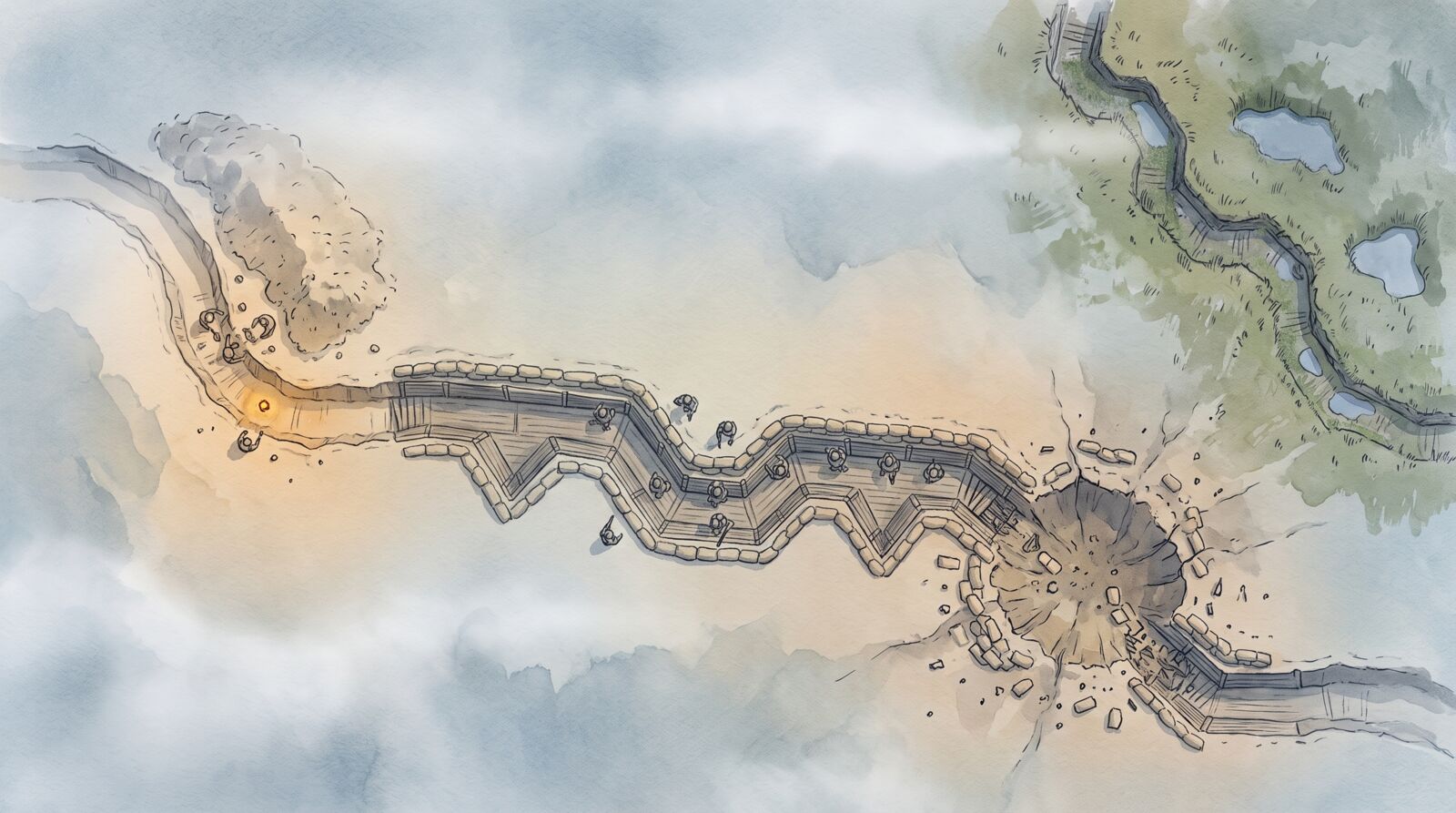
Fire trenches zig-zag. Every 8 to 11 m the trench steps around a traverse, a block of earth and sandbags, so the line is a row of short fire bays. A traverse stops a shell or sweeping fire from running along the whole trench, so damage stays inside the bay that was hit. Each corner looks hand-dug, not drafted. Along the way you will see sandbag tops, timber walls, duckboards, dugout doors, wire belts and MG nests at the corners.
How they read from above
Historic Environment Scotland describes First World War trenches in aerial photographs as "an endless row of teeth, or a child's drawing of castle battlements, surrounded by the black dots of shell holes". That is how Shellfall's trenches should read: crenellated front lines, softer wavy communication trenches, and a stipple of craters whose density shows how hard a sector has been fought over.
Damage and collapse
- Each trench segment has a fortification value from 0 to 100. HE lowers it in a radius, and a direct hit on a segment removes 30 to 60.
- At 0 the segment collapses. The walls cave in, sandbags spill, and the trench becomes a muddy dip. Defenders there lose their cover and take double damage.
- Collapsed segments next to each other make a breach. Breaches invite charges, from either side.
See Shells and The living battlefield.
Capture
When a sector is captured, its trenches flip to the new owner's colours over a few seconds: sandbag caps, flags, uniforms. The old reserve becomes the new front.
Abandoned, never gone
A trench nobody uses changes slowly over the days of the war. Its walls slump, water gathers in the floor, grass creeps over the edges, and it grows shallower. In the end it is a grassy scar in the field, but it never vanishes. If soldiers move back in, they clear it and the slump slowly reverses. See Terrain that remembers.
To push your own line forward, see Digging a new line.