The hot zone
The stretch of front where most of the fighting is. Where it sits, how it drifts, and why you might report there.
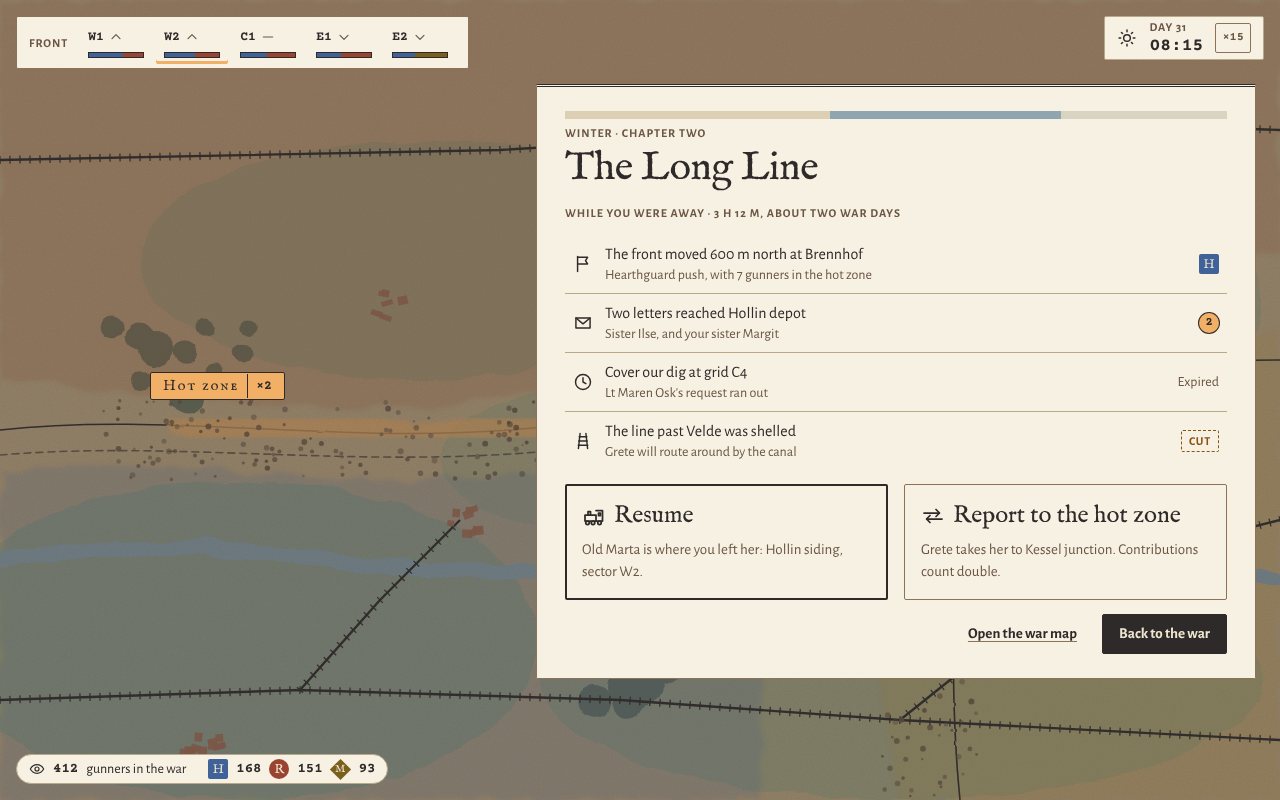
The war is wide, but there is always one stretch of front where it matters most. The hot zone is that stretch: about 6 to 8 km of front where most of the fighting is. On the map it glows amber, and its label reads "Hot zone ×2". It is never the only place worth fighting, but it is always the busiest.
Where it sits
The hot zone sits on the stretch of front with the highest activity: the most players in range, plus the most recent advances. In single player it is the war's main offensive, steered by the campaign. See The campaign: four seasons.
How it moves
| Rule | Value |
|---|---|
| Width | About 6–8 km of front |
| Fastest drift | About 2 km per 10 real minutes |
| Pulled to the weakest sector after | About 30 real minutes without moving |
The hot zone drifts along the front toward wherever the biggest recent advance happened. When one side breaks through, the hot zone follows the breakthrough, which pulls the other side's gunners there to fight back. If it has not moved for about 30 real minutes, it is pulled toward the weakest sector, so the fighting never freezes. In single player the same drift rules apply to that offensive's advances.
Resume or report
When you come back to the war, you choose where to start.
- Resume. Old Marta is where you parked her.
- Report to the hot zone. Your train is sent by rail to the nearest friendly siding in reach of the hot zone. The trip happened while you were away.
Why go there
- Contributions count double for the front.
- Recon support is stronger: more balloons and planes.
- More officer requests appear.
- Special shells are resupplied faster.
See Recon: spotters, balloons and planes, Operations and requests and Shells.
Outside it
The rest of the front still moves, only more slowly. Quiet sectors are where flanking, rail raids and story operations happen. Nothing makes you go to the hot zone: where to be is your call, and often the biggest one you make. See One continuous war and The rail network.
In the shared war
When the shared war arrives, the hot zone is where most players are fighting. The war map shows the fronts, recent movement arrows and where players are fighting, and reporting to the hot zone is the quickest way to join them. See The shared war.